ONE:Whilst the rebellion was raging in Scotland there had been an attempt to change the ministry, and to place at the helm Lord Granville. That nobleman had so engrossed the favour of the king, that Pelham and his brother, Newcastle, found their measures greatly obstructed by Granville's influence, and suspected that they would soon be called on to give place to him. They determined, therefore, to bring matters to a crisis, confident that Granville would never be able to secure a majority in either House against them. To furnish a reason for their tendering their resignation, they demanded the place which they had promised to Pitt.
ONE:On the 7th of July the British and Prussian forces entered Paris. The former encamped themselves in the Bois de Boulogne, and the Prussians bivouacked along the Seine. There they came into full view of the Bridge of Jena, so named to commemorate the victory of Buonaparte on that field, so fatal to the Prussians, and of the column in the Place Vend?me, erected with cannon taken from the Austrians, and bearing insulting mementoes of the defeats of Prussia. The Prussians had already lowered the statue of Napoleon from the top of the column, and were beginning to demolish the bridge, when the Duke of Wellington interfered. He represented that, although these objects were justly offensive to Prussia, they ought to be left to the decision of the King of France, in whose capital they were, and that the name of the bridge might be changed. Blucher was unwilling to give way, and also insisted on the levy of a military contribution on the city of Paris of one hundred million francs, as some reparation for the[104] spoliations of the French in Berlin. Wellington suggested that these matters should be left for the determination of the Allied sovereigns, and at length prevailed.News arrived that the king, by proclamation, had prohibited the export of arms and military stores to America. This news was received with a burst of rage. The people of Rhode Island, who had burnt the king's schooner, The Gaspee, seized forty pieces of cannon on the batteries defending the harbour, and carried them into the country. The people of New Hampshire surprised a small fort called William and Mary, garrisoned only by one officer and five men, and carried off the ordnance, arms, ammunition and military stores. Everywhere orders were issued for the purchase of arms and ammunition; for training the militia; for erecting powder mills, and manufactories of arms and shot, as well as for making saltpetre. So far as it depended on the people of Massachusetts, it was already rebellion. Still, however, the other colonies, except, perhaps, Virginia, were far from this bellicose temper. The colonies, in general, thought the measures of the late Congress too strong; and the State of New York, in spite of the impetuosity of such men as Jay, carried a vote rejecting the resolutions of the Congress.
TWO:[See larger version]
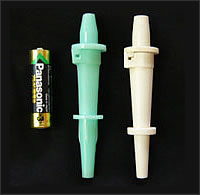
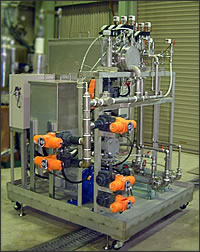
A hydrocyclone (liquid cyclone) injects treatment solution into stationary equipment to perform separation, classification, and concentration, and is an innovative separator with a very simple structure and no drive unit.
Structure of a hydrocyclone (liquid cyclone)
A suspension containing fine particles of several micrometers or more is supplied to a cylindrical container circumferentially at high speed. And as a result it starts to rotate and a centrifugal force is generated. At this time a gravitational acceleration of several tens of thousands of G is generated in the circumferential direction, and thus leading to fast sedimentation and concentration of the fine particles. The separated concentration can be freely selected by changing the supply rate (supply pressure and flow rate) and the flow ratio of the outlet. Our hydrocyclone (liquid cyclone) was designed and manufactured to classify and concentrate fine particles, and so has a small element.
THREE:
Equipment costs can be reduced.
Operating costs can be reduced.
Maintenance costs can be reduced.
Any change in raw material and product can be easily addressed.
Large amounts can be treated in a small area.
Separation and cleaning are easy because of the simple structure.
Simplified control
This equipment can be operated in synchronization with external devices.
Alarm and interlock mechanism.
THREE:In the face of such facts it was clear that something must be done, even by a Protectionist Ministry, to diminish the effect of the growing belief that bad legislation was at the bottom of the country's difficulties. In the spring men had looked eagerly for the Budget of the new Ministry. It had been bitterly remarked that at the time when Parliament was prorogued there were nearly 21,000 persons in Leeds whose average earnings were only 11-3/4 d. per week¡ªthat in one district in Manchester alone a gentleman had visited 258 families, consisting of 1,029 individuals, whose average earnings were only 7? d. per head a week; and that while millions were in this deplorable condition, the duty on wheat stood at 24s. 8d. a quarter, and Sir Robert Peel and his colleagues demanded four months' leisure at their country abodes before they would permit the Legislature to take the distress of the people into consideration. At length came the meeting of Parliament, at which the Queen in person read the Speech prepared by her Ministers. It acknowledged with deep regret "the continued distress in the manufacturing districts," and that the sufferings and privations which had resulted from it had been "borne with exemplary patience and forbearance." Finally, her Majesty recommended to the consideration of both Houses "the laws which affect the import of corn and other articles." What was the intention of the Ministers was not then known; but it was already understood that, unlike their rivals, who had proposed a fixed duty, the new Government would attempt some modification of the sliding scale. In the account of these transactions which Sir Robert Peel left to be published by his executors after his death, he says:¡ª"One of the first acts of the Government over which I presided (the Government of August, 1841) was to propose a material change in the Corn Law of 1828. I brought the subject under the consideration of my colleagues by means of written memoranda, in preference to proposals made verbally. In the first of these memoranda I recommended my colleagues to undertake the revision of the Corn Laws of 1828, as an act of the Government. In the second, after I had procured their assent to the principle of revision, I submitted a proposal in respect to the extent to which such revision should be carried, and to the details of the new law." Then were seen the first symptoms of that estrangement from his party which reached its climax in 1846. Glaring as was the necessity for change, and evident as it was, even to the body of the landowners, that they must choose between the mild reform of Peel and the more objectionable measure of his antagonists, there were members of the Cabinet who would still have held out for no concession. The Duke of Buckingham retired from the Ministry, and the Duke of Richmond refused to allow his son to move the Address."Father is gone!
Classification and concentration for the manufacture of inorganic powder materials
Classification of ceramic materials
Removal of fine particles, including iron powder
Removal of fine particles from pigments
Removal of fine organic particles from solvents
Separation of starch and yeast
Removal of fine particles from high-temperature strong acid solutions
Removal of fine particles from low-temperature solutions